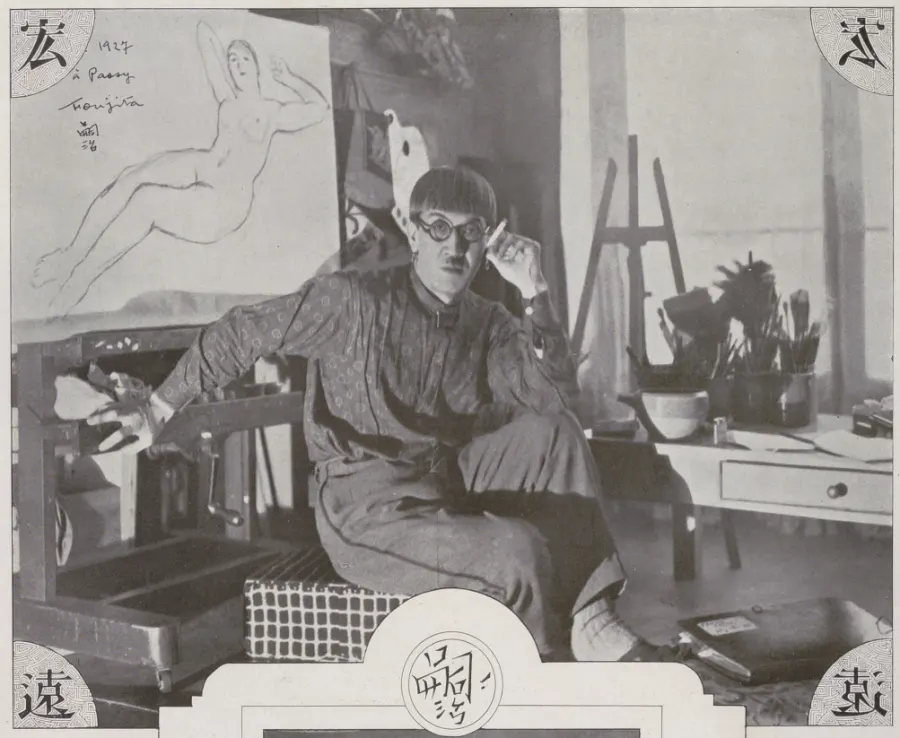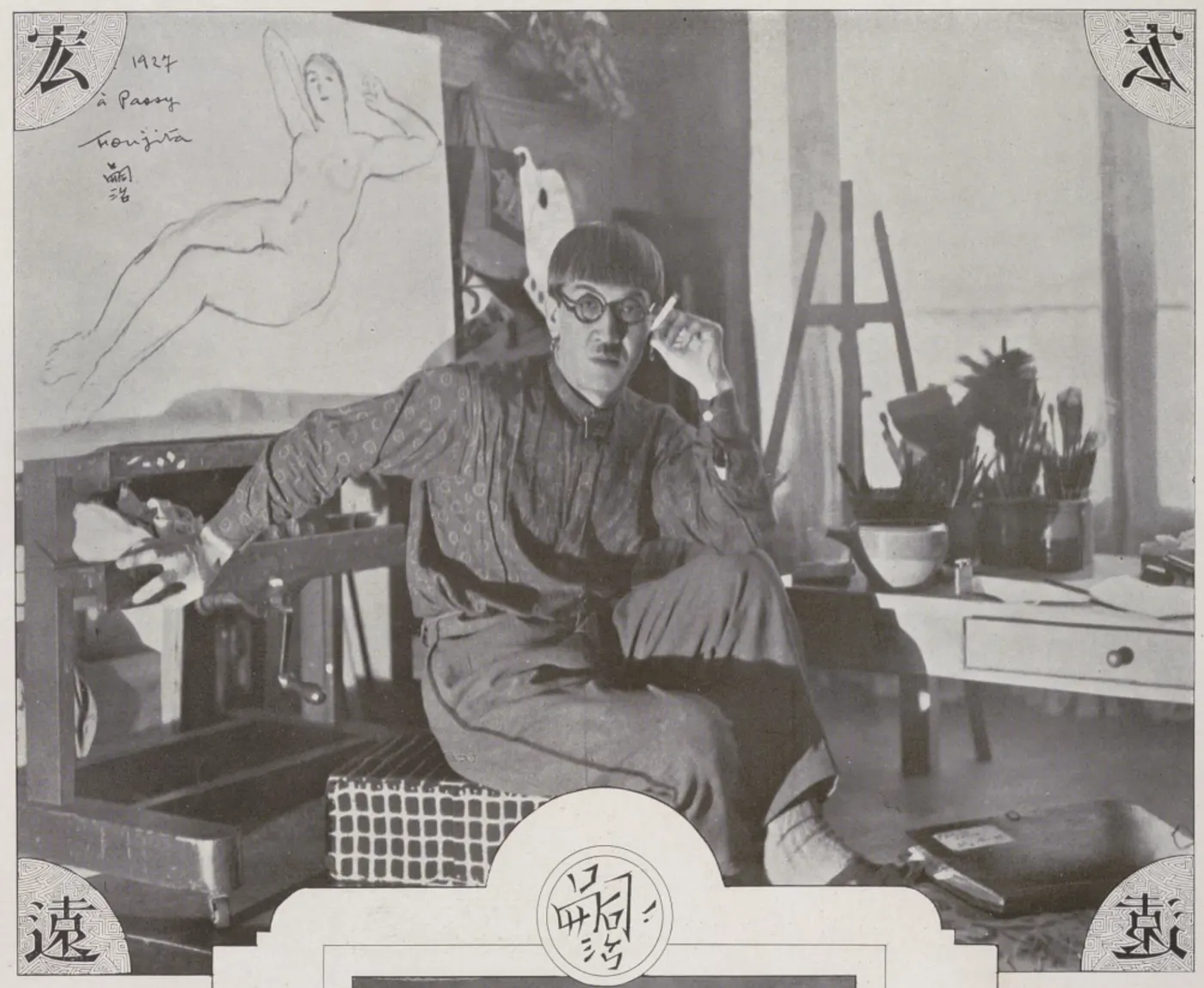
Tsuguharu Foujita
1886 — 1968 · Tokyo · ParisFoujita arrived in Paris in 1913 with a Tokyo art-school training and a determination to find a register that belonged neither entirely to the Japanese tradition he came from nor to the School of Paris he had come to join. He found it on the back of his cats.
He settled in Montparnasse, took rooms near the rue Delambre, and within a decade was one of the most discussed painters of the quarter — a fixture at the Café du Dôme alongside Modigliani, Soutine and Pascin. The work that made his reputation was built on a milk-white ground that he prepared himself, working with talc and lead white until the canvas was as smooth and as cool as porcelain. Over it he drew in fine ink line — a sumi-trained hand applied to oil-painting’s surface — and the subjects, more and more often, were nudes and cats.
The cats were rarely accidental. They sat beside his sitters, on his own shoulder in self-portrait after self-portrait, alone in the centre of small panels. The two-cat panel Les deux chats — two animals held in fine ink line over an ivory ground — shows the discipline he had perfected by the late 1920s: a sumi-trained contour applied to oil-painting’s surface, the cats held forward, the room around them quieted to almost nothing.
His later years took him through Japan during the war, through a difficult postwar return to France, and finally into the Catholic faith and a programme of religious painting at the chapel he designed in Reims. The cats, however, were the thread running through everything — the small, exact figures that grounded a long and complicated life in the practice of looking carefully at one quiet animal at a time.
The milk-white ground was prepared with talc and lead white until the canvas was as smooth and as cool as porcelain. Then the cat was drawn in ink, in a single sitting. The Heritage · on Foujita